Book Review So You Want to Talk About Race
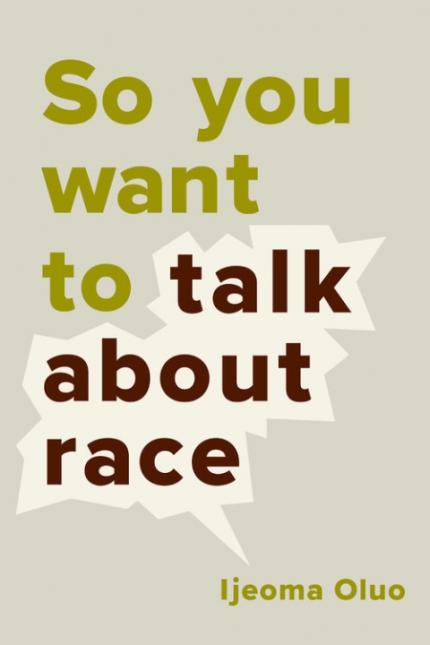
While white readers are going to proceeds insight on hard-to-understand-unless-you've-lived-it topics in So Yous Desire to Talk About Race, readers of color generally will find camaraderie and a resource in Ijeoma Oluo's conversational approach to race, racism, and racial violence in America.
The book is divided into capacity that tackle issues such as the myth that class is a bigger problem than race or what racism and micro-aggressions actually are. But what makes So You Desire to Talk About Race such a strong add-on to books that address race is that the author also turns her centre toward much more complex issues like intersectionality, the school-to-prison pipeline, and cultural appropriation with wit and heart.
In her introduction, Oluo sets up her experience growing up in a racially marked body in America, from the micro-aggressions that populate her daily life to the pleasures of Jollof rice, family, and the glories of black culture — things like jazz, Toni Morrison, hair braiders, and sugariness murphy pie.
But in this book, she's non writing to celebrate, she's writing to educate and to fight back against this fact: "It is very hard to survive every bit a adult female of color in this earth and I remember saying once that if I stopped to feel, really experience, the pain of the racism I encountered, I would kickoff screaming and I would never ever end."
Personal experience means that Oluo has had conversations about race her entire life, and she recognizes how utterly exhausting it is to exist "the blackness friend" or to have to coexist in a majority-white environment.
While Oluo tells stories about her life in Seattle in social club to frame definitions and unpack concepts, she too provides easy-to-understand, step-by-step lists for budgeted conversations about race:
"Ask yourself: Am I trying to be right, or am I trying to do better? Conversations almost racism should never exist virtually winning. This battle is too of import to exist and then simplified. Yous are in this to share, and to learn. Yous are in this to do ameliorate and be better. You lot are non trying to score points, and victory volition rarely look like your opponent conceding defeat and vowing to never debate with you again. Because your opponent isn't a person, it's the system of racism that often shows up in the words and actions of other people."
Passages like this build understanding in a style that readers volition savor because they make talking about race as clear as it can exist.
Oluo is intellectually precipitous and even funny, and this is ane of the strengths of her book. For example, she writes: "White supremacy is this nation'south oldest pyramid scheme. Fifty-fifty those who have lost everything to this scheme are yet hanging in there, waiting for their turn to greenbacks out."
With such punchy one- and 2-liners, Oluo builds agreement. Readers may find the directly address — the "you" she points at frequently — uncomfortable, just it'southward appropriate. Combined with the book's overall tone, it offers an intimate experience where readers can process situations before they enter into their own conversations most race.
One of my concerns with So Yous Want to Talk About Race is that while the book is well-grounded in the African-American experience, it extends itself to talk about other people of color and Indigenous peoples, and these moments occasionally show Oluo's own bones assumptions that create an inhospitable climate for other racially marked bodies.
For case, she reveals her colonial positioning of Ethnic peoples by calling them "Indigenous Americans." This volition exist read equally extremely problematic — a micro-assailment in a book almost understanding micro-aggressions — for Indigenous readers. Yet, Oluo understands that "even afterwards having spent years of my life focused on racial justice, Asian Americans are at times an afterthought in my piece of work."
And she owns this, in the Asian-American context, modeling what she preaches when she says, "I, like so many of us, take to do better."
In the end, white readers open to educating themselves will come up away from So You Want to Talk Most Race with a fairly nuanced understand of race relations and of the traumas enacted, in particular, on black bodies through the systematic inequalities present in American society.
[Editor's annotation: Author Ijeoma Oluo indicates that future editions of her book volition use the term "Indigenous peoples" rather than "Indigenous Americans."]
Jenny Ferguson is Métis, an activist, a feminist, an auntie, and an accomplice with a Ph.D. She believes writing and teaching are political acts. Border Markers, her collection of linked flash-fiction narratives, is available from NeWest Printing. She lives in Haudenosaunee Territory, where she teaches at Hobart and William Smith colleges.
Like what we practise? Click hither to back up the nonprofit Independent!
Source: http://www.washingtonindependentreviewofbooks.com/index.php/bookreview/so-you-want-to-talk-about-race
0 Response to "Book Review So You Want to Talk About Race"
Post a Comment